

The current news cycle is replete with stories of the ‘affordability crisis’ impacting the average American household, and political discussions become infused (inflamed) with people on both sides of the issue. The polar ends of this financial and philosophical spectrum are those households on one side (generally lower income) crying for relief and federal assistance. This group contrasted with those households who feel their income taxes are high enough ‘as is’, and who believe their opponents problems would be best solved by more elbow grease. The stark contrast between the two is growing, not diminishing, and the right answer has great economic import for America as you will see below.
First, some financial facts on the ‘average’ household in America[i]:
- $121,000 (Average Household Income)
- $364,000 (Average Home Value (offset by a $252,000 mortgage))
- $6,700 (Average Credit Card balance)
- 1.5 – 2 (The average ‘months of cash on hand’ (not 3-8 as recommended))
Notwithstanding those averages, let me add two other pieces of affordability data and one big caveat:
- The average price of a home has gone up 55% since COVID in 2020[ii]
- The 2026 price of a new car is $49,121[iii]
* Caveat… ’averages’ are misleading. Statistically speaking, what you have to watch is ‘median’, which means half the country above and half the country below
Having raised this last point, be aware of this startling statistic. The MEDIAN total household savings for retirement is $1,000.[iv] That’s not a misprint. If you only have $1,000, the truth is you don’t have an affordability crisis, you have a survival crisis. You will take help wherever you can get it.
Aggravating all the above are two additional economic realities:
- The last 50 years have seen the widening of the household wealth in American. Since 1976, the top 1% of all households have seen their wealth increase by a dramatic 13-fold[v]. Home valuation increases and a booming stock market have had that effect. Nonetheless, if you didn’t buy a home and haven’t saved money, this train has passed you by.
- Beyond the forementioned wealth measurement, there is a widening income gap between the lowest 20% of households and the top 20%. A common formulaic expression of this gap is called the Gini Coefficient (named after the Italian statistician Corrado Gini who invented it), a metric whose value ranges from 0 to 1 (perfect inequality to perfect equality). It is true that the ‘unadjusted’ raw Gini Coefficient has been increasing, thus showing increased disparity *(Census Bureau says up 21%). However, other papers argue that when you include taxes that come out of wages (progressive taxation) and add in the substantial rise in low-income household transfer payments (i.e. federal, local and State subsidies), the inequality has actually decreased by 3%[vi]. Nonetheless, keep in mind that surely the costs of healthcare and childcare have exceeded the inflation rate so some of that increase would be natural[vii].
Now you have a plethora of economic facts. But – don’t forget this psychological reality: When all your friends are poor, you feel ‘normal’ and okay. If, however, you look at social media and everyone is rich, you will feel poor no matter how much money you have yourself.
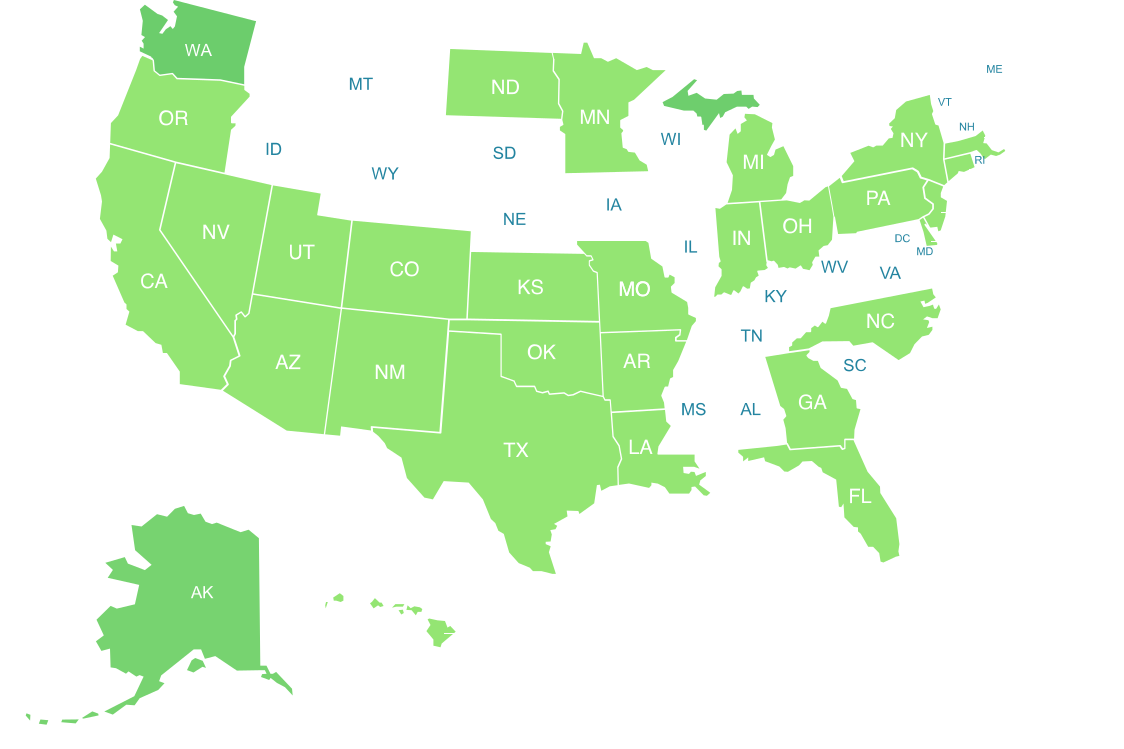
An easy solution by many progressive circles is to increase taxes and afford more transfer payments. That proposal works well on a chalkboard, but not on the sidewalk. Why? Because people leave high-tax states. Recent data[viii] reveals a steady trend of people leaving high tax States (California, New York, Illinois, Massachusetts, New Jersey) and going to low / no tax States, taking their earnings power, net worth and wallets with them[ix]. It’s simply hard to make a better stew if someone takes the pot away.
Solutions are needed and good intentions are a dime a dozen. I don’t like people offering one sentence answers to complex problems. What is urgently required is honest dialogue between these two opposing camps, these ‘two cities of thought’ as Charles Dickens wrote about back in 1859. In my opinion, education is the key to it all and now you have vastly more objective financial knowledge than most. Working together we will have a sounder world economic foundation, and that benefits us all.
Pat Zumbusch
Founder and CEO
[i] “Shocking Money Stats; How Much The Average American Makes, Saves and Owes” (Erin Talks Money, Podcast, 2025)_
[ii] “Which Markets Have Seen the Greatest House Price Appreciation Since the Pandemic?” (National Association Of Home Builders (NAHB.org/blog), July 13, 2025)
[iii] “Average New Car Price Drops; $20K Car Likely Dead” (Sean Tucker, Kelly Blue Book, February 11, 2026)
[iv] “The typical U.S. worker has $955 saved for retirement, report finds” (Aimee Picchi, CBS News Money Watch, February 6, 2026)
[v] “Gains By The Superrich Alter The Economy” (Rachel Louise Ensign, Wall Street Journal, Weekend Edition, March 28, 2026)
[vi] “Income Equality, Not Inequality, Is the Problem” (Phill Gramm and John Early, Wall Street Journal, August 29, 2022)
[vii] “Are Transfers Replacing Work for America’s Poor?” (Tyler Turman, The Daily Economy, February 18, 2026)
[viii] “Research Shows Direct Link Between State Income Taxes And Migration” (Sandra Baltazar Martinez, Riverside News / University of California – Riverside, April 3, 2024)
[ix] “The High-Tax Wealth Flight Continues” (Wall Street Journal, August 28-29, 2026)