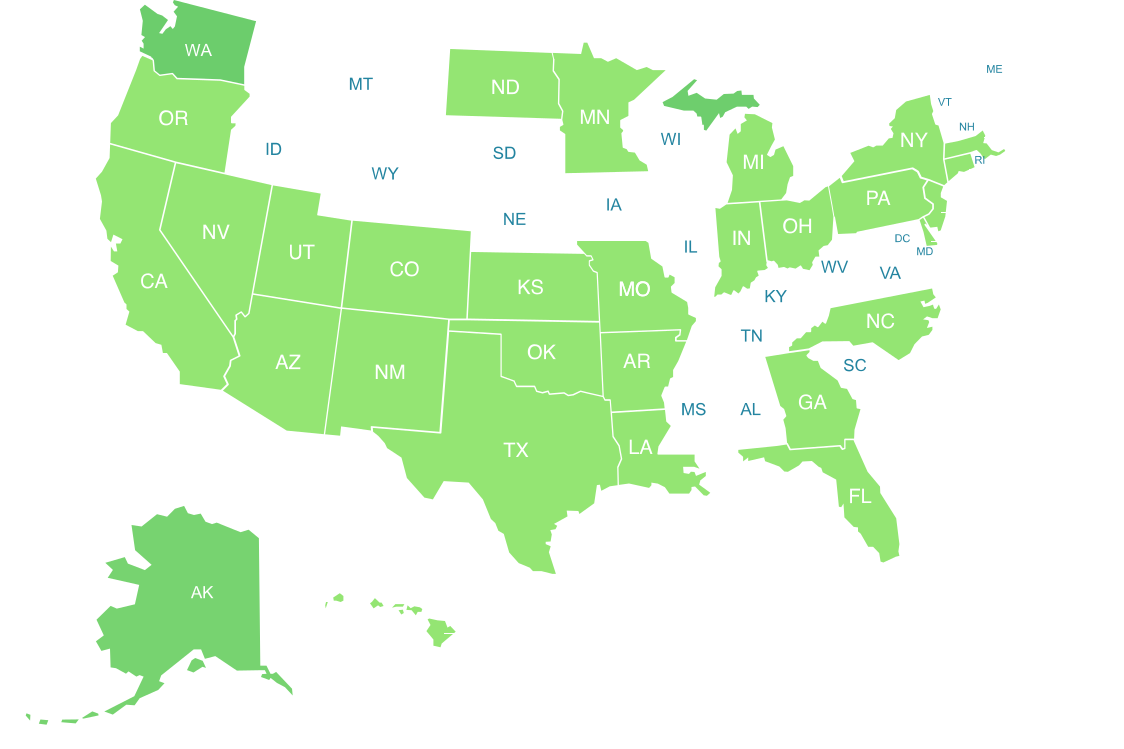


When the Steve Miller band came out with “The Joker” in 1973, the verses sang of being ‘a joker, I’m a smoker, I’m a midnight toker’. The song went to the top of the billboards even though the marijuana use it referenced was illegal then, but now it’s legal for medical use in 48 out of 50 States, and legal for recreational use in 24.[i] However, in this letter I don’t to talk about dope and tokers, but of tokens. Tokens, a current topic in the financial world, are a concept of asset ownership that sounds a little dopey on first hearing, but might soon be coming to a storefront near you.
Today when you buy stock in a company on the public stock exchanges, you legally acquire a share in that company (thus the term shares of stock). The monetary value of any company’s stock is priced on a per share basis in exchanges from Amsterdam to Zambia. Through your exchange of dollars for your share (or a Euro’s in the first case and Kwacha’s in the second), you henceforth own a share in the assets of that company, as well as being entitled to a respective share of all the future profits of that company. You certainly hope your share price goes up. However, this letter isn’t about valuation and growth, but instead it’s about the mechanism for transaction, ownership and title and how it may drastically and fundamentally change.
Today your ownership of a share (we are talking of a stock, but it could be a share of a bond, or a piece of real estate, etc.) is recorded by the financial services industry under the supervision of the Securities and Exchange Commission (SEC) or other regulatory bodies (FINRA, etc.). Your ‘share’ has been obtained by taking money from a bank account in your name – associated with your Social Security number – and exchanged for a share in that company. If you were an investor from a foreign country, your payment was likely facilitated by SWIFT, the secure international messaging service for financial transactions (Society for Worldwide Interbank Financial Telecommunications (SWIFT)). In the vast majority of cases, that share you now own, was formerly owned by someone else with a different Social Security number (or maybe it was an EIN, an Employer Identification Number, if we are talking a Trust account or a company bank account). Your transaction to ‘buy a share’ was mandated to be reconciled that very night by the custodian who holds that share (be it e-Trade, Fidelity or Schwab, etc.) and by rule of law all transactions must ‘clear’ – i.e. all the buyers and sellers agree on the transaction, all shares are accounted for, and there is not a penny not accounted for every single day on every stock exchange, in every currency, in every country, for every single person, in every account (IRA, Roth IRA, 529 plan, etc. etc.). In the United States alone, this suite of transactions and recordings happens for over 14 BILLION shares per day[ii] – and that’s just on public exchanges – and that’s just stocks. Effects on the bond market would be similar and the global size of that market is even bigger than equities. The custodian must be clear about who owns (or who had owned) a particular stock or bond on a very particular day (called the ‘record date’) so that they know to whom to credit the dividends or interest coupon payments. Please stop reading now for just a moment to reflect on the vast scale of this endeavor, to simply appreciate the complex but seamless financial machinery that is needed to effortlessly move one share from Jane Doe to John Smith.
Whew! Can you imagine how all this was done when we didn’t have the electronics and communication we have today. Literally, as late as the time of the midnight toker song, orders were placed by telephone and share certificates were issued instead. Some of you may have found those beautifully embossed parchments of equity ownership in the back of your grandparent’s bedroom closet or in a safety deposit box. They would be printed out with the shareholder’s name and mailed out to the new owner to hold. The old owner had to similarly go into some exchange office and ‘sign over’ his shares (endorse them) so the agent could broker the shares (thus the term) to a new owner. That’s why share ownership was generally a rich man’s game until Charles Schwab came on the scene and opened up what became the first retail stock exchange for the average man and woman on the street.
All of the above history is simply a primer to the topic of ‘tokenization’. A movement is now afoot to substitute – or at minimum complement – organized exchanges between institutions with ‘digital tokens’ that enable you to transact directly with the buyer or seller. You could own a token of Microsoft, which is a share of Microsoft to be sure, but with three game-changing differences;
- There is no middleman (or woman), and your transaction isn’t recorded on a ‘brokerage statement’, but your asset is held instead in your new ‘digital wallet’, accessible only by you.
- You would not have to ‘clear’ through banks, custodians and exchange operators and be forced to wait (sometimes a day or two) for all the financial gears to mesh but instead your transaction would be immediate (and irreversible).
- The mechanism to safely conduct such decentralized asset buys and sells would be blockchain (a “legal pipe” for transactions that I mentioned before when I first talked in these pages about Bitcoin). Because describing blockchain would need to be the subject of its own letter, let me just say blockchain promises to be a reliable and secure electronic means of recording and tracking the provenance of any particular asset. It’s the literal Digital Ledger to back up your Digital Wallet.
You could imagine where all this could go…but probably not to the full extent because it would be akin to trying to tell your family about electricity when you were lighting oil lamps or about the internet when the Pony Express was galloping along. The process of decentralizing asset ownership and finance itself (thus creating the term DeFi) is certainly promising if it helps move more people out of poverty, cut costs, or make solid new investment opportunities available. Though currently tiny in scale as it relates to traditional financial assets, it is nonetheless up 300% in the past 20 months[iii]. However, unless appropriate safeguards are in place, it can also bring about lack of transparency and control. Wellspring will always seek to keep you on the front edge of investment ideas to elevate your likelihood of financial success. However, leading edge is not bleeding edge, and we will always seek to find that right balance to be worthy of the valuable trust you have given to us. While other things may go up in smoke, our commitment to you is unwavering.
It remains my deep and distinct honor to serve you.
Patrick Zumbusch
Founder and CEO
[i] Where Is Weed Legal? A Guide to Marijuana Legalization” (Elliot Davis Jr. and Marissa Yelenick, US News and World Report, June 30, 2025)
[ii] “U.S. Equities Market Volume Summary” (CBOE.com, December 21, 2025)
[iii] “Larry Fink and Rob Goldstein on how tokenisation could transform finance” (Economist, December 1, 2025)